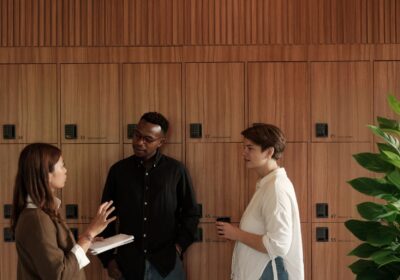
Social learning theory has gained a reputation as a crucial part of education and ongoing learning – but what role does it play in creating a successful learning and development environment?
In this article, we speak to Vicki Young, Head of BRC Learning and experienced professional learning provider, to discuss the importance of social learning in L&D, and how you can implement aspects of social learning theory in your training sessions.
What is Social Learning?
The term ‘social learning theory’ was first pioneered by clinical psychologist Albert Bandura in 1977. He suggested that humans not only learn via direct action and consequence, but also by observing and learning from the actions of others and the consequences of those actions. He later expanded on this in his social cognitive theory in 1986, where he added that additional drivers of behaviour include expected outcomes (as informed by your surroundings) and confidence in one’s actions.
This theory has gone on to be a driving force behind theories in traditional education and methods of therapy. However, it also has an important role to play in learning and development. Processes such as observation, sharing knowledge and collaborating with fellow colleagues play an instrumental role in building empathy across roles in your business and strengthening the achievement of learning outcomes.
Vicki speaks to the importance of creating a collaborative and empathetic space, stating: “Ultimately, it doesn’t really matter what job role you come from, what size business, or what organisation – a lot of the challenges people face are similar.”
And the stats on this are clear: in the CIPD’s Learning At Work Report in 2023, 91% of teams studied were found to develop skills more effectively together, and learner engagement increased by 30% when in a social, collaborative learning environment.
When approaching learning and development in this way, not only do individuals learn and grow independently, but the shared experiences between colleagues build a culture that encourages ongoing growth through collaboration.
But what role can you play as a learning provider to foster an environment of social learning?
Strategies for Implementing Social Learning in L&D
1. Create time in your agenda for collaboration and discussion
Setting a clear agenda for your learning and development session is important – this is something we discuss more deeply in our article on neuroinclusion at events, where the importance of structure is highlighted.
However, your session’s structure shouldn’t come at the expense of organic conversation and collaboration. In fact, this should be accounted for and anticipated!
Vicki states, “It’s having the confidence to be fluid with the agenda and allow conversations to play out. When people start to open up, you’re creating a psychologically safe environment for them to be themselves, and to share their experiences. That’s where the real richness of the fruit happens in those discussions.
“It’s important to allow time within your agenda to facilitate those real meaningful conversations, to ask some of those open-ended questions and give people time to reflect on what they’ve taken from their conversations, what they’ve learned from others across organisations and job roles. It gives participants a completely different perspective.”
2. Consider the format of your L&D session
Each individual is different, and where people feel most comfortable disclosing and having meaningful conversations is different from person to person. For some, that may be online – for others, these conversations are best in-person.
However, consider when choosing your format the flexibility you’ll have to create comfortable settings for conversation and collaboration.
Vicki expands on this, saying, “As a trainer or facilitator, it’s about reading the room, making time to speak to people in coffee breaks, and checking in on people. Maybe you could pair people up or create smaller groups to have more one-on-one discussions.
You’ll have people who will be more confident to speak out in a virtual world, but it is more challenging when people don’t know each other to encourage them to open up and talk. The more you meet in a virtual world with the same people, the more comfortable they will become.”
In short, while in-person sessions offer more flexibility in format for discussion, virtual sessions, particularly those hosted over several different days, can offer more continuity – both of these aspects contribute to creating a safe space for social learning.
For those in-person sessions, consider the location of your session and its impact on the efficacy of the learning within it. Leaving your office and heading somewhere new can encourage new ideas and break colleagues away from the usual routines of the day, providing opportunities for innovation. This could be as simple as booking a flexible event space nearby – a change in schedule and scenery is invaluable for productive learning.
Discover flexible bookable rooms at The Form Rooms in Covent Garden, easily accessible by public transport
As Vicki states, “It’s in a trainer’s lens to bring people out of their comfort zones. A new environment, outside of work, encourages attendees to focus on themselves, the conversations and the discussions they’re having, and on their own development.”
3. Remain focused on your learning outcomes
Social learning thrives from flexibility, but it’s important that conversations remain focused on the learning outcomes of your session.
Vicki speaks to the importance of that agenda as a grounding agent, stating, “Having an agenda means there’s a purpose to why you’re there. You have objectives to achieve for the day, and learning outcomes. Knowing the flow of your event well enough to allow time for really good conversations is important, but so is providing opportunities for people to follow up on and continue those conversations in coffee breaks, or over lunch, or by connecting on LinkedIn.”
Social learning doesn’t just take place within your session. Done right, it has lasting effects on how participants in your learning session engage with one another going forward, and this creates long-lasting positive learning outcomes.
Where is Social Learning Most Effective in L&D?
Vicki states, “Social learning can work in most learning and training environments. Having an element of social learning in play gives people the opportunity to collaborate, digest new information and decompress. A lot of people like to reflect on new information, and having those conversations brings some of that to the surface a lot quicker than mulling it over in your own mind.”
This concept is reinforced by research from Charles Jennings in 2013, where he created a framework for high-performance development: the 70:20:10 framework, where 70% of an individual’s learning is acquired through experience, 20% is through learning and developing with others, and 10% is through formal training.
This means a significant amount of the impact from your L&D sessions will come from the fruitful conversations your attendees share during and afterwards. In short, social learning is crucial in any learning and development programme.
And it’s important that social learning doesn’t stop at the door on the way out. Vicki says, “It’s so easy to come out of any learning experience and then, suddenly, youre back to the day job, and everything you’ve learned is somewhere in the back of your mind.
“Sometimes it takes the creation of a safe space – for example, I once set up a Whatsapp group for attendees and then removed myself so there was still that psychologically safe space to continue having conversations – or even a little reminder, ‘Oh, yes, I was going to follow up with that individual’, these things help to continue the conversation and remind people they have a shared experience together when they went through the learning programme.”
Start creating your next thriving social learning environment – book flexible spaces at The Form Rooms
Social learning, despite its long-standing and embedded reputation as a learning theory, still has a crucial role to play in learning and development – and as L&D changes and evolves over time, it has a new importance in making sure knowledge and connections last over time.
Vicki concluded her conversation with us by sharing this:
“At BRC Learning, we have many senior people come and speak at our events, many of whom have been delegates of our programmes before, and they speak often about the network around them.
“I still have people in my network I’ve met on training courses over the years, people I’m still connected with due to that element of social learning.
“Never underestimate the value it can bring you, whether that’s today, tomorrow, or ten years down the line – especially as an emerging or transforming leader.”